
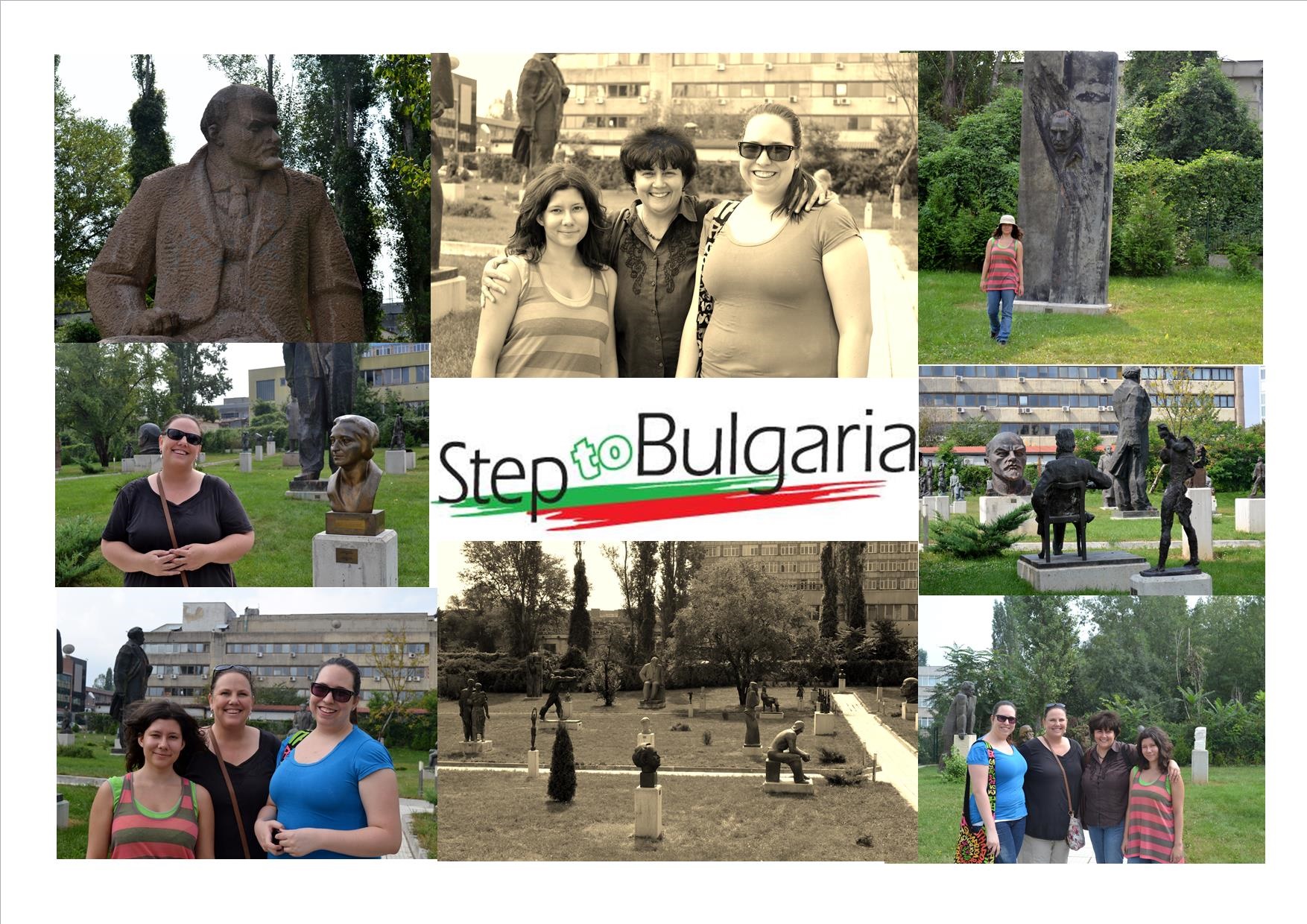
Sofia Museum Field Trip - from the Socialism Art to Rodin!
On Saturday, August 24, two of the most motivated students of Step to Bulgaria – Peta and Ciara Small from South Africa, my daughter and I went on a trip to see some of the museums of Sofia. Here is what Peta and Ciara shared about their experience that day:
“If you ever wondered where all those unwanted statues of Lenin from old photo’s of Bulgaria 20+ years ago ended up, you’ll find many of them at the Museum of Socialist Art, along with the red star from atop Bulgarian Communist Party House. There’s also a gallery with many fine paintings, rejoicing in such catchy titles as ‘Youth Meeting at Kilifarevo Village to Send Worker-Peasant Delegation to the USSR,’
The museum isn’t the easiest place to find, as it is housed in a gated Ministry of Culture building next to the Sopharma Business Towers. There is no sign anywhere, but you can catch a gimps’ of the big red star in the garden along with the giant statues of Lenin.
It has seemed ironic to me that in in my 7months of living in Bulgaria, in every museum I have visited in a number of different town’s, there seems to be a rather strange void of information for the 45 years of Bulgarian history from 1944 – 1989! And finally, I got to see the much talked about red star and the imposing statues of Vladimir Lenin and Georgi Dimitrov at the Museum of Socialist Art.
I understood why they called it Museum of Socialist Art instead of Museum of Communism. But to be honest, I have no idea why the word “museum” is used at all, because it basically is just a great gallery of socialist art. You can see impressive statues and sculptures in the yard as well as beautiful paintings in the exhibition hall. I think if it weren’t for the little room off the gift shop where a plethora of stirring old propaganda films, proclaiming the values of socialism and the virtues of Dimitar Blagoev and Georgi Dimitrov, were being shown the actual reference to a museum would be somewhat amiss. And to be brutally honest, if anything the old black & white’s gave me a lot more insight into what Bulgaria was like 22+ years ago than I have been able to gain from any of the ‘official tourist’ places I have visited.
As a South African, and coming from a country which has a similar an equally dubious history, I had anticipated seeing the ‘then and now’ depiction of Bulgaria pre and post the fall of communism, similar to what we have in South Africa pre and post apartheid, and as such have been quite astounded by the lack of available information. In fact, it is only when speaking to the local Bulgarian that I as a foreigner have been able to get a feel for what life was like under communism.
In my opinion, the current generations in both countries needs to learn from the past so as to not only educate them, but also to empower them to mold their future – or as the Historian Robert Pen Warren was known to have said, “History cannot give us a program for the future, but it can give us a fuller understanding of ourselves, and of our common humanity, so that we can better face the future.”
Following on from our visit to the Socialism Museum of Art, we visited the National Gallery to view the artworks of Auguste Rodin. As a South African, it was quite a surreal experience stepping into the gallery and immediately being surrounded not only by the works of a true genius, but also by the sheer privilege of being able to view these incredible works of art for a mere R50.00 (6BGN). This is one of the things I LOVE about living in Bulgaria.
Rodin undoubtedly understood the human form and his works display a real sense of movement and fluidity. Rodin’s muscles, bones and facial expressions are all taken straight from life and nothing is idealized or over dramatized as some works of art were at this time. Rodin’s use of ‘average’ subjects connected me to his work in an almost inexplicable way.
But, the incredible depth of emotion that Rodin was able to evoke in me particularly in his ‘The Thinker” and “Monumental Head of Pierre de Wissant”, was a start contrast to the feelings of resolve and determination that the images of Lenin, Marx, Engels, Stalin, Lenin, Blagoev and Dimitrov evoked in me.
Reflecting back on the day I couldn’t help but recall that wandering amongst the great statues in the Socialist Museum outdoor area, I noticed that the workers’ theme in the socialist park is represented by sculptures of working men and women who embody the typical heroism of the working class in Bulgaria and these typical figures of socialist realism, namely partisans, Red Army men, workers and farm workers, positioned strategically among the monumental sculptures of famous Bulgarian and Soviet communists.
It occurred to me, that even as I was wondering amongst the giant characters, the communist leaders are still perceived as “common people”, trying to mingle with the proletariat as they did in the period of socialist society. However, the size of both types of figures themselves represents the gap that existed between the working class and its leaders.
The highlight of the trip for both Ciara and I was undoubtedly having the bubbly and gregarious Nadia Staneva along with us, who’s eye witness accounts of what life was like during communism, helped to give a much fuller perspective and insight into the fledgling adult democratic Bulgaria that we as foreigners see today.”